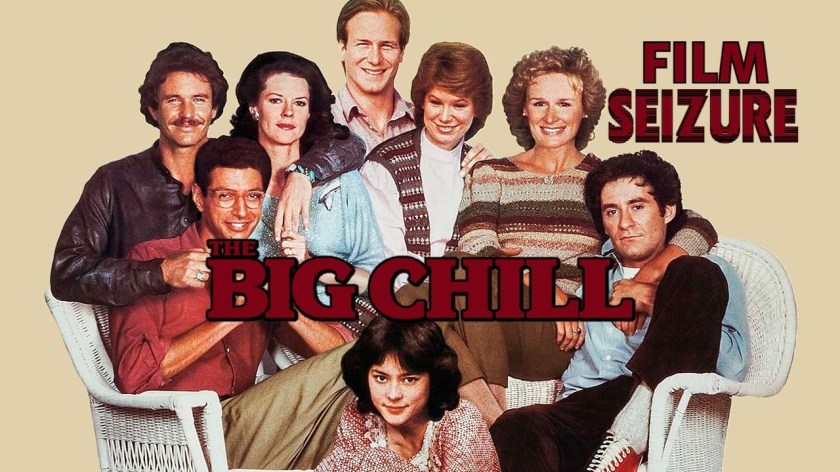
This week’s Film Seizure episode discusses a movie that launched a subgenre of comedy-dramas we affectionately dub nostalgiasploitation. We’re talking Lawrence Kasdan’s The Big Chill from 1983.
Three old friends get together to talk about movies.

This week’s Film Seizure episode discusses a movie that launched a subgenre of comedy-dramas we affectionately dub nostalgiasploitation. We’re talking Lawrence Kasdan’s The Big Chill from 1983.
 Film Seizure Podcast
I saw this in the theater when I was 13. A friend and I had seem trailers for Terms of Endearment and The Big Chill all summer, watching Return of the Jedi and usually one or two other pictures over a few visits, and made a point of catching them in the fall.
This is Kasdan’s Altman movie, having the viewers be flies on the wall of a weekend with friends; Gosford Park circa 1983. They enjoy each other, and challenge each other, which only real friends can do, people who know who you really were and still are, even though you aren’t currently who you used to want to become. They don’t change each other, and the conversations are not less relevant just because the listener doesn’t transform that very weekend. Most people don’t, and that reality, along with the enjoyability of real, goalless conversation, is a part of life we weren’t getting, and still don’t for the most part, in our move-the-plot screenwriting (even move the character development plot), and one of the movie’s points was that it’s just as interesting a part of life as are the pivotal moments. It’s how we get to know people past how they initially present to us, or even present themselves at first.
This was a tough episode to hear, not because you don’t all love the movie. I get just not finding the film, or the characters, engaging. Any movie can do that with any person; it’s just personal chemistry sometimes. But… Well, hang on.
I once talked with an evaluator for The Heartland Film Festival about Jim Sheridan’s wonderful, so human and lovely movie, In America. She’d voted against their giving it their imprimatur (which they may have done anyway; there were many voters), and I asked her what didn’t work about it, how it wasn’t a “Truly Moving Picture,” which was their motto at the time. She didn’t dismiss the film, and acknowledged its consistent quality, agreeing with me that its positives were of the highest caliber, but she added, “The family still came into the country illegally, and were never held accountable for their wrong. What will that tell the world?”
I hid my stun, as I was in a service position at the moment, and I liked her quite a bit. I could only get out, “Well… Okay.”
I felt a little bit like that listening to this episode, like the movie was regarded as crucially flawed for not meeting a code, like a Hays code type of thing, only with different targets, or that it actually had met it, but either way the code had to be met or it was too wrong-headded of a movie. I’m not sure just swapping targets from well-meaning, poor, Irish immigrants to well-meaning, well-to-do also-whites makes the approach any more palatable. No, that’s not right, it doesn’t; my iffyness is because I am clearly going off a lot of reading between the lines here. It wasn’t stated what intentions would have been deemed better for the film to have had. I wish you had spelled it out, because I have no doubt it is much more nuanced than what I can discern, and it likely would have been int’resting.
There is a great little exchange from a little seen Christmas movie called The Holly and the Ivy (on Kanopy, and recommended. It’s a good kind of sad):
Aunt Bridget : What type do you consider yourself?
Margaret Gregory : One regards oneself as an individual, Aunt Bridget. Types are other people.
One only needs 10 minutes of real conversation with anyone to know them as far more detailed and complex people than their categories’ definitions, yet there’s a contemporary trend to get the lesson of that moment backwards, not “No one is really a type; we’re all individuals, and that’s how we should regard and treat people,” but “See yourself as a type, and everybody else as well,” (then, for some, meet out the judgments accordingly). I felt like I was hearing that impulse a little when Geoff talked about your responses to Boyz ‘n the Hood. Why wouldn’t any three middle-aged white guys have very different ways that they came to the movie, and have read it from three different perspectives? Would you ever think, “Schindler’s List is not a movie you would expect three post-collegiate black women to have all experienced from three different perspectives in three different lives?” You not only wouldn’t say that out loud, but I’ll wager the thought wouldn’t even occur to any of you, because I believe you already accept, for that demographic, that people are more than that definition. And everyone is. Seeing people only as defined by their categories is not a privilege bestowed on the world once, for example, they cross someone’s idea of their having too much money. No one’s soul goes away when they get pigeonholed into a socially poo-pooable set. The Big Chill was an ensemble production about a specific set of sufficiently complex friends, all with different relationships, holing up over a weekend. Why was there an extra box the film needed to check about them?
I feel like I’m floundering in trying to clarify. Let me try this: Do you personally know any people who could be in this Big Chill demographic, and if so, do you regard them the way you think this movie should regard these characters? Or do you mock them, or treat them like they are The Problem anytime you engage with them? Do you make sure they never lose sight of their rottenness? I’d bet not; you clearly three are thoughtful, considerate people, and I’d be surprised if you treat anyone you know well enough to say, “Yes, I know that person” as less than a real human being. Is a movie allowed to do that too, and to invite its viewers to see the humanity in these flawed people who are growing in awareness of their possible misdirections?
At the very same time we were pre-screening In America, we had a movie in the theater called Max, about an art dealer, played by John Cusack, and his protégé, a young, aimless Adoplh Hitler. The movie was challenged for ‘humanizing’ the not-yet dictator, and one critic countered in his review that if Hitler is a monster, that’s his excuse. Ebert wrote, “But of course Hitler was human, and we must understand that before we can understand anything else about him. To dehumanize him is to fall under the spell which elevated him into the Fuhrer, a mythical being who transfixed Germans and obscured the silly little man with the mustache.”
Does a movie have to agree with you about its characters, or society, or your morals or ethics to be worthy? Must it judge them, or complete the intellectual equation? I hope not. That question came up a lot with Wolf of Wall Street; I don’t know where you all fell on that one. If it were so, I would have to dismiss The Godfather, Miller’s Crossing, The Sporanos and a whole slew of exceptional gangster movies, which are usually about mere bullies, imperious, greedy, violent blowhards who take the concept of loyalty to the level of idolatry, “La Cosa Nostra über alles,” and who usually get their way. But my answer to the question, “Why would you want to watch a movie about a bunch of entitled dicks?” would be, “Because realistically presented people are almost always interesting, especially the ones who are different from me. Which is all of them.”
LikeLike